CrossFit, Hyrox, bodybuilding, powerlifting, and functional training compared
Before you pick a program, understand the landscape. Every training style has a legitimate use case — and a set of people it is completely wrong for.
Style 01
Bodybuilding
Bodybuilding trains for maximal muscle hypertrophy and body composition using isolation and compound movements, moderate-to-high volume, and progressive overload. The goal is to look as muscular and defined as possible — not to lift the most weight or run the fastest. Phases alternate between a bulk (caloric surplus) and a cut (caloric deficit). VBE's Hypertrophy and Recomposition programs are evidence-based bodybuilding — the same science without the extremes of competitive prep.
Strengths
Limitations
VBE programs are evidence-based bodybuilding at their core
Style 02
Powerlifting
Powerlifting is a competitive strength sport built around three lifts: the squat, bench press, and deadlift. Training focuses on moving maximum load for 1–5 reps, with very high intensity (%1RM) and periodised programming that peaks for a competition. The goal is how much you can lift on a specific day — not how you look. VBE's Foundation program borrows heavily from powerlifting principles, but is not a dedicated powerlifting program.
Strengths
Limitations
Foundation borrows powerlifting structure; VBE is not a strength sport program
Style 03
CrossFit
CrossFit trains 'constantly varied functional movements performed at high intensity.' Workouts (WODs) combine Olympic lifting, gymnastics, and conditioning in timed or scored formats. It is deliberately broad — the goal is to be competent at everything rather than optimal at any one thing. It has an exceptional community culture and builds real cardiovascular fitness. However, it is not optimised for maximum muscle hypertrophy, and the constantly varied nature makes progressive overload harder to track systematically.
Strengths
Limitations
Different goals — VBE is optimised for physique and strength, not general fitness
Style 04
Hyrox
Hyrox is a competitive fitness race: 8 km of running broken into 8 × 1 km segments, each followed by a functional exercise station — sled push, ski erg, rowing, burpee broad jumps, wall balls, lunges, and sandbag carries. It demands running endurance, muscular endurance, and mental toughness. Hyrox has exploded since 2018 because it is open to all abilities. Training requires a dedicated hybrid programme combining running volume with strength-endurance — resistance training is a core foundation for any Hyrox athlete.
Strengths
Limitations
A VBE strength base helps Hyrox athletes — but Hyrox needs its own dedicated program
Style 05
Functional Fitness
Functional fitness prioritises multi-joint compound movements that translate to real-life demands — carry, push, pull, squat, hinge, rotate. It avoids isolated machine work in favour of free weights and bodyweight patterns that mirror daily activity. 'Functional' has become a marketing term, but at its core reflects a legitimate philosophy: build strength you can use, not just display. VBE's Foundation program is strongly functional by nature — every movement pattern trained has direct real-world carry-over.
Strengths
Limitations
Foundation is functional in structure — VBE adds the hypertrophy layer on top
Style 06
Calisthenics
Calisthenics uses bodyweight as the primary resistance, progressing through increasingly difficult movement variations — push-ups to ring dips, bodyweight squats to pistol squats, pull-ups to muscle-ups. It develops exceptional relative strength and body control. The limitation is the ceiling on progressive overload — once you can do 20 pull-ups, adding difficulty becomes complex. For maximum muscle building, weighted resistance training outperforms calisthenics at intermediate and advanced levels.
Strengths
Limitations
VBE uses weighted resistance — calisthenics is a different tool with different goals
Style 07
HIIT
High-Intensity Interval Training alternates short bursts of maximal effort with recovery periods. It is time-efficient for improving VO₂ max and cardiovascular fitness, with a meaningful EPOC effect that extends calorie burn post-session. However, HIIT is frequently overhyped as a fat-loss tool — it burns far fewer total calories than a steady 45-minute run, and adds significant recovery load that can interfere with resistance training. VBE treats HIIT as an optional add-on during Recomposition, not a primary training method.
Strengths
Limitations
Optional add-on during Recomposition — not a standalone VBE training method
The VBE Position
Why evidence-based resistance training wins for most people
The research on resistance training is unambiguous: progressive overload with compound and isolation movements is the most efficient path to improved body composition, strength, metabolic health, and long-term physical function. Every other training style has its place — but for the person whose goal is to look better, be stronger, and feel more capable in their body, structured resistance training with intelligent nutrition outperforms every alternative on every meaningful metric.
What VBE training delivers that other styles don't
Weight goes up in measurable increments every session, week, and month. Progress is trackable and objective.
Prioritise specific muscle groups, address imbalances, and sculpt your physique intentionally — not just generally "get fit."
The only modality with strong evidence for maintaining muscle mass, bone density, and metabolic rate into your 60s, 70s, and beyond.
A strong resistance base makes you better at CrossFit, Hyrox, running, sport, and daily life. It is the foundation, not the ceiling.
Foundation → Hypertrophy → Recomposition — the VBE sequence
Each program solves a specific problem. Run them in order and you build a physique that compound interest can't touch.
Program 01
Foundation
The starting point — and the most underrated program in fitness. Foundation is not a beginner program in the dismissive sense. It is where everyone, regardless of experience, learns to move with precision, load with intent, and progress with discipline.
Best for
Anyone new to structured training. Anyone returning after a break. Anyone who has trained inconsistently and wants a proper base before specialising.
Program 03
Recomposition
The simultaneous fat-loss and muscle-retention block. Recomposition is the most technically demanding program — not in complexity, but in patience. It requires a precision calorie strategy, higher protein, and a training structure that preserves every gram of muscle while leaning out.
Best for
Intermediate-to-advanced lifters who want to lean out without losing hard-earned muscle. Those who have a training base and want a dedicated cut phase with full retention protocols.
How Foundation, Hypertrophy, and Recomposition differ
Same discipline, different tools. Here is exactly what changes between each block and why those differences matter.
| Variable | Foundation | Hypertrophy | Recomposition |
|---|---|---|---|
| Primary focus | Movement quality + linear strength | Muscle size via volume accumulation | Fat loss with full muscle retention |
| Training split | Full body × 3 | Upper / Lower × 4 | Push / Pull / Legs × 4 |
| Weekly volume | Low–moderate (9–12 sets/muscle) | High (14–20 sets/muscle) | Moderate–high (12–16 sets/muscle) |
| Rep range | 3–6 (strength) + 8–12 (accessory) | 6–15 across all movements | 8–15, controlled tempo |
| Intensity (%1RM) | 75–90% (heavy compound focus) | 65–80% (moderate, volume-driven) | 60–75% (metabolic + retention) |
| Rest periods | 2–4 min (compounds), 60–90s (accessories) | 60–120s (most sets) | 45–90s (density emphasis) |
| Nutrition approach | Maintenance or small surplus | Controlled surplus (+200–350 kcal) | Moderate deficit (−300–500 kcal) |
| Protein target | 1.6–2.0 g/kg | 1.8–2.2 g/kg | 2.0–2.4 g/kg (muscle-sparing) |
| Cardio requirement | Optional (stay active) | Minimal (protect recovery) | Recommended (LISS 2–3× / week) |
| Expected result | +20–40% strength, better technique | +2–5 kg lean mass over a block | −3–6% body fat, muscle maintained |
| Difficulty | Beginner–friendly | Intermediate | Intermediate–Advanced |
Rep range alone does not determine adaptation. Volume, proximity to failure, rest periods, and progressive overload interact to determine whether you're training for strength, size, or retention. These programs use different combinations of all four variables — not just reps.
The results you can expect, and how long they take
Marketing language promises transformations. Evidence tells you exactly what changes — and how quickly.
Program 01
Foundation
Foundation is the program most people skip and the reason most people plateau. The 8–12 week investment in technique, motor patterns, and base strength multiplies every program that follows it.
What you will adapt
Your nervous system learns to recruit more muscle fibres per rep. Strength rises without visible size change — this is normal and valuable.
Tendons and ligaments adapt slower than muscle. Foundation's lower volume protects these while they catch up. Skip this and injuries follow.
Squat, hinge, push, pull, carry — the five fundamental patterns become automatic. This transfers to every program you run for the rest of your life.
3 days per week, same time, same structure. The most underrated adaptation is simply showing up consistently for 8 weeks.
Realistic timeline of results
Soreness, learning to brace, getting familiar with movements. Strength may not go up yet — this is adaptation, not failure.
Linear strength gains begin. Adding weight every session is normal. This is the fastest period of strength development most people ever experience.
Visible shape changes emerge. Strength is 20–40% above starting numbers. Confidence in movements is high. You are ready for Hypertrophy.
Do not leave Foundation because it feels easy. Leave Foundation when you can hit the top of every rep range with 2 reps in reserve, on every set, for 3 consecutive sessions. That is completion — not boredom.
Program 02
Hypertrophy
Hypertrophy is where physiques are sculpted. The Upper/Lower split allows enough volume per muscle group to drive meaningful size, while keeping session frequency high enough that each muscle is trained twice per week — the sweet spot for most natural lifters.
What you will adapt
Volume and moderate loads expand fluid volume inside muscle cells — visible size, the fullness and roundness you see in the mirror.
Strength work builds contractile protein. You get bigger and stronger simultaneously — not one or the other.
Higher rep, lower load work trains you to feel the target muscle working. This skill stays with you for every program that follows.
Shorter rest periods and higher volume build work capacity. You get fitter alongside getting bigger.
Realistic timeline of results
Adjustment phase. The jump to 4 days and higher volume will feel hard. This is adaptation stimulus, not overtraining.
Visible size changes start. Clothes fit differently. Pump in training is stronger and more consistent.
Measurable mass gain. Natural lifters can expect 1–2 kg of lean tissue — less than influencers claim, more than pessimists admit.
Natural muscle gain caps at roughly 0.5–1 kg/month for an intermediate lifter eating in a controlled surplus. Anyone promising more is selling you something. Over 12 months, that compounds into a meaningful physique change.
Program 03
Recomposition
Recomposition runs on the hardest fuel: precision. It requires you to be in a moderate deficit while training hard enough to signal muscle retention — and eating enough protein that your body has no reason to cannibalise what you built. Done right, it reveals the physique that was always underneath.
What you will adapt
A consistent moderate deficit strips adipose tissue over weeks. Slow progress is the right progress — too fast and muscle follows the fat.
Resistance training signals mTOR to preserve contractile tissue even in a deficit. This is why you must keep lifting — not just cut calories.
Calorie moderation + resistance training dramatically improves how your body handles carbohydrates. You get leaner and metabolically healthier.
The shape built in Foundation and Hypertrophy becomes visible as fat drops. Recomposition reveals, not creates, the physique.
Realistic timeline of results
Initial water weight drop (0.5–2 kg). Scale moves fast at first — don't mistake this for fat loss. Actual fat loss takes 3–4 weeks to measure.
0.3–0.6 kg of fat per week. Clothes are noticeably looser. Waist and face show first clear visual changes.
3–6% body fat reduction. Muscle definition is visible. Photos from Week 1 vs Week 16 are unmistakable.
Cutting calories too aggressively. A deficit over 500 kcal/day dramatically increases muscle loss and hormonal disruption. Slow and precise beats fast and reckless — every single time.
Answer three quick questions
No quiz. No algorithm. Just honest criteria.
Choose Foundation if…
Choose Hypertrophy if…
Choose Recomposition if…
The VBE Progression Path
The correct sequence for most people is Foundation → Hypertrophy → Recomposition → back to Hypertrophy. Run each block to completion before moving on. One full cycle takes 30–40 weeks — just over 6 months. That is one year to a physique most people spend their whole life looking for and never finding because they kept switching programs before finishing the one in front of them.
Full schedule, progressions, and principles
Select a program below to see the complete weekly structure, warm-up protocol, and progression rules.
Lose Fat • Keep / Build Muscle
Lose Fat While You Build a Stronger, Leaner Physique
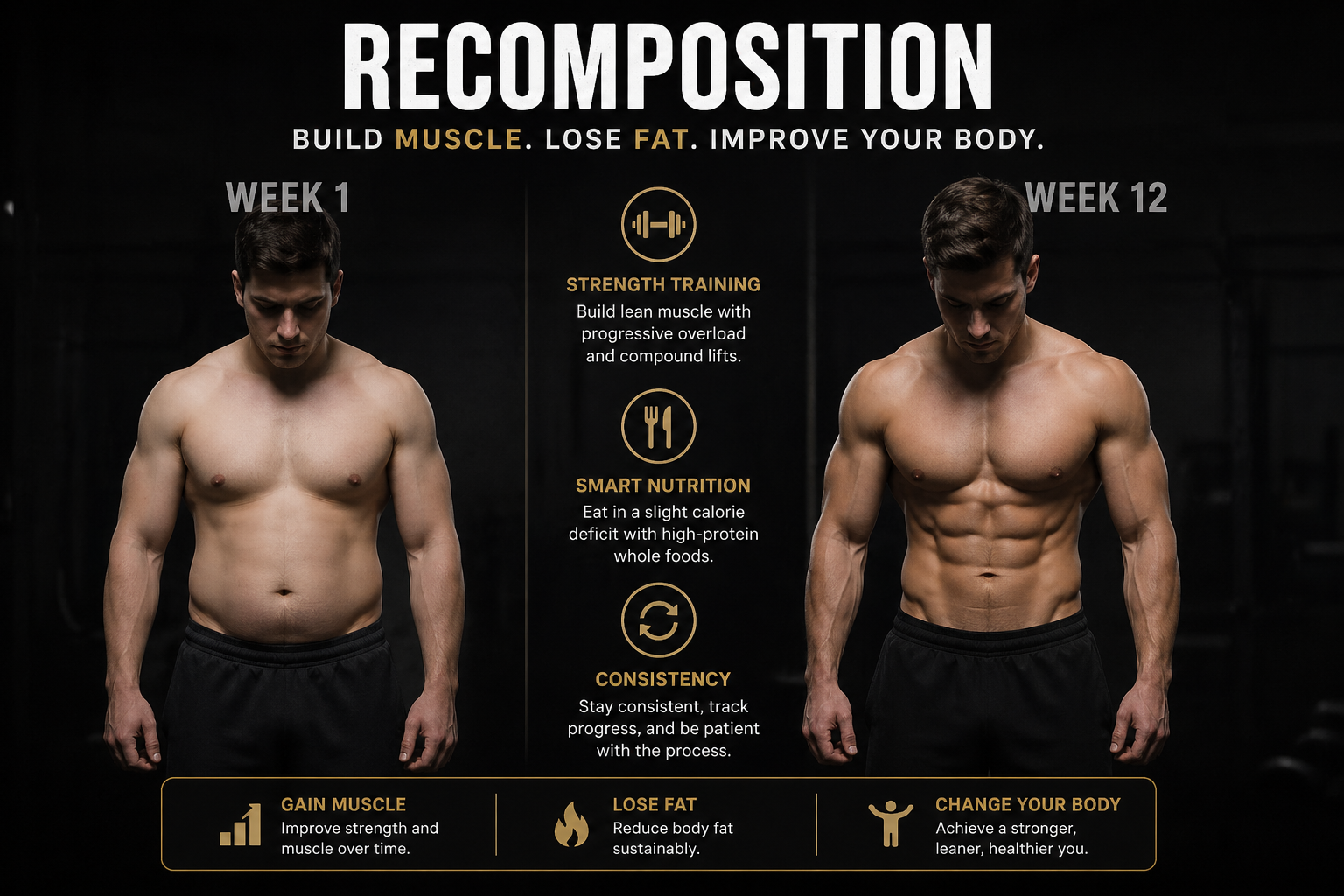
Recomposition is the most misunderstood phase in fitness. Most people think you must choose: cut hard and lose muscle, or bulk and add fat. The truth is more useful. With high protein, smart calorie management, hard strength training, and patience, the average lifter can build muscle while losing fat — particularly beginners, returnees, and anyone who has cycled diets without serious lifting. The trick is precision, not extremes.
Six principles that drive every Recomposition session
Programs change. Principles don't. Master these and you will outlast every fad you survived.
★ Principle
Lift heavy enough to keep what you have
Strength training is the signal that says 'do not strip the muscle' while calories are restricted.
★ Principle
Protein is non-negotiable
1.8–2.4 g/kg lean mass. Protein protects muscle in a deficit and increases satiety. This is the lever that makes recomp possible.
★ Principle
A small deficit is the sweet spot
10–20% below maintenance. Aggressive cuts strip muscle and energy; tiny deficits move too slowly. The goal is sustainable, not dramatic.
★ Principle
Steps before cardio
Use 8,000–12,000 steps/day to widen the deficit without competing with lifting recovery.
★ Principle
Track more than the scale
Waist, hip, photos, strength logs, fit of clothes. Scale weight in a deficit is noise punctuated by signal.
★ Principle
Diet breaks save recomp runs
Every 6–10 weeks, take 5–10 days at maintenance. Hormones reset, hunger drops, training rebounds.
8–10 min — every session, no exceptions
Warm-ups are not optional. The session begins when the body is ready, not when you walk through the door.
General raise
5 min easy cardio. In a calorie deficit, cold joints are less forgiving — this step matters even more than in a bulk.
90/90 hip rotation
60 sec/side. Unlocks hip internal and external rotation needed for squats, lunges, and deadlifts.
Dead bug
2 × 8/side. Low-load core activation before heavy compound work — builds bracing habit without depleting energy.
Band pull-apart
2 × 20. Rear-delt and rotator cuff activation. Protects the shoulder joint when pressing in a deficit, when connective tissue feels tighter.
Goblet squat (very light)
2 × 8 at empty hands or very light weight. Pattern practice before loading anything. Ramp to working sets.
Ramp sets
2 ramp sets for each main lift: 40% × 5, 65% × 3. Shorter than hypertrophy ramp — conserve energy in a deficit.
A proper warm-up increases muscle temperature (improving force production), lubricates joints with synovial fluid, and activates the nervous system. The first working set should feel familiar, not like a test.
Rest Period Guide
Rest periods in a recomp are slightly shorter than pure hypertrophy to increase calorie expenditure — but never so short that working sets degrade.
Recomposition — full weekly schedule
Run this for 8–12 weeks before changing it. The boring repetition is the secret.
Heavy push/pull
Heavy squat
Volume push/pull
Hinge / Glute focus
Numbers like 4 × 5–8 mean: 4 working sets, hitting between 5 and 8 reps. When you reach the top of the range with 1–2 reps in reserve on every set, add load (typically 2.5 kg) the next session.
Add load only when reps have earned it
These are the rules that keep you progressing for years instead of weeks.
How to add weight
Mistakes to avoid
Recomposition — common questions
Answered honestly, with the evidence to back every position.
Can I really build muscle in a deficit?
Yes — clearly demonstrated for beginners, returning lifters, anyone who has done long diet/restriction cycles, and anyone overweight. Advanced natural lifters at low body fat will see slower or maintenance-level results, which is still success.
How big should the deficit be?
10–20% below maintenance. For most people that's 250–500 kcal/day. Aggressive deficits are how recomp turns into a regular cut.
How long does a recomp take?
Plan 12–24 weeks per phase. Slower than a cut, more sustainable, far less rebound.
Should I do cardio?
Walk daily. Add 1–2 short sessions of zone 2 (20–40 min) if you enjoy it. Avoid HIIT in the early weeks of a deficit — it competes with lifting.
What about women in recomp?
The protocol is the same. Protein, lifting, slight deficit, steps. Add awareness to the menstrual cycle: hunger and water retention rise around the luteal phase. Track 28-day averages, not daily numbers.